Do Whales Come Close To The Boat In Geographe Bay?
Whales do approach boats in Geographe Bay, but the law sets the distances and the whale sets the encounter. Here is what the rules and the operators actually say.
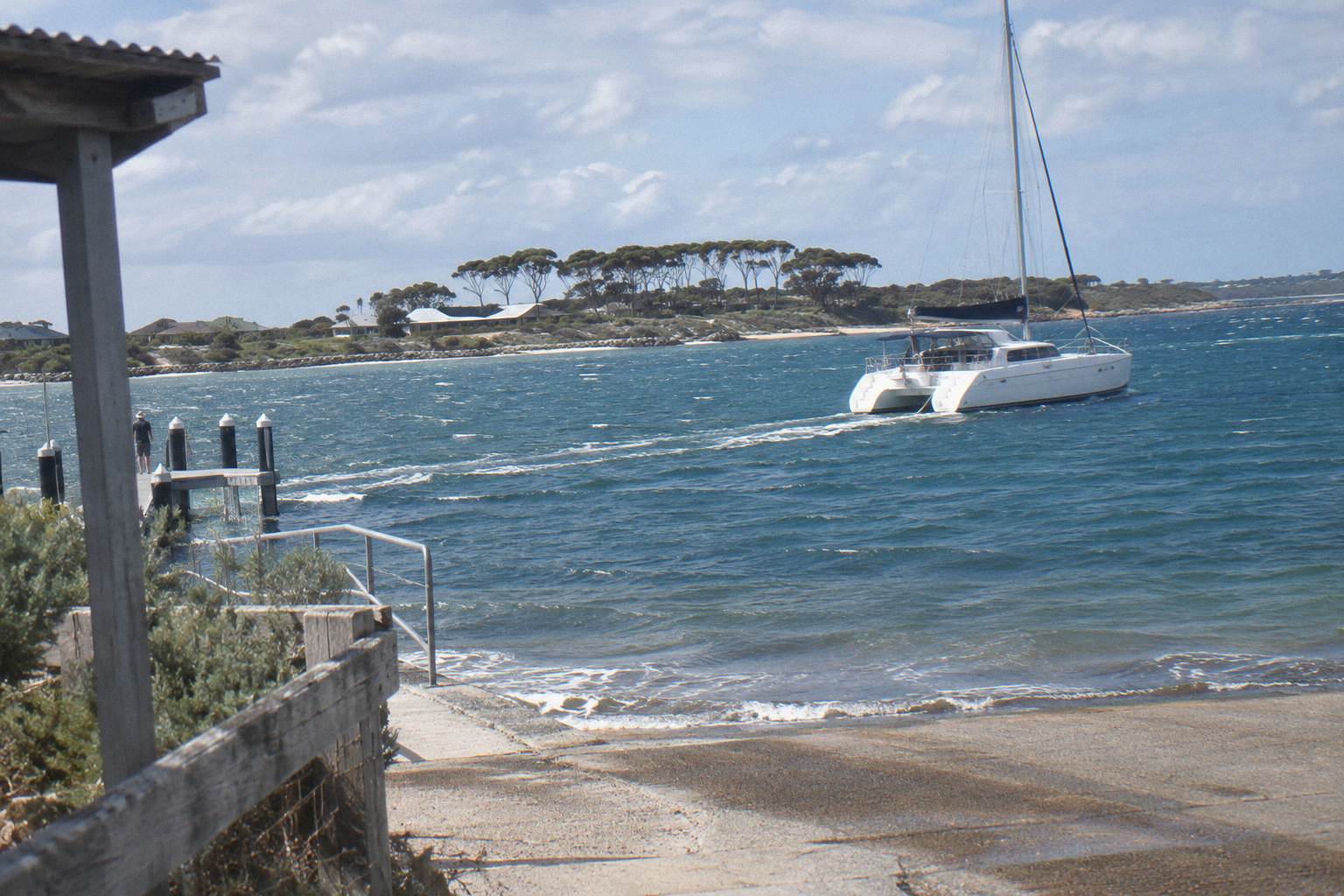
Yes, they do, and often. A vessel in Western Australia must keep at least 100 metres to the side of a whale and 300 metres in front of or behind it, but nothing in the law stops a whale from swimming to the boat. When that happens, the rules require the crew to cut the engines or drift away slowly, which is exactly why some of the closest views happen with the boat sitting still.
That single distinction, distance rules that bind people and not whales, is the heart of every close encounter story from this coast. Skippers cannot chase. They cannot position the boat inside the arc. What they can do is hold a lawful distance, keep quiet, and let a curious humpback or a resting mother make the next move. In a shallow, sheltered bay like Geographe, whales frequently do.
The Dunsborough Whale Watching operators describe the bay as a rest stop on the southern migration, and the behaviour that follows is what brings animals alongside. Humpbacks travelling south, mothers with calves, and the odd southern right will linger, roll, spy-hop or pass under a stationary hull. Nobody on the crew can promise any of it. The operator's own FAQ describes its vessels as keeping "a specific distance" and prints no figure, which is honest in a way a number would not be, because the law, not the brochure, sets the geometry.
What follows is a plain-language read of the rules, the operator statements and the behaviour, so you know before you board what "close" legally means, who controls it, and why the engines going quiet is usually the signal that something is about to happen. The month by month whale season in Geographe Bay is covered separately, because timing and proximity are two different questions, and confusing the two leads people to book the wrong month for the wrong reason.
What The Law Says About How Close A Boat Can Get
Western Australia's Biodiversity Conservation Regulations 2018 set the distances. A vessel must stay at least 300 metres from a whale within a 60 degree arc to its front or rear, and at least 100 metres to its side. A person in the water must stay 100 metres away, and a drone at least 60 metres. Breaking the distance is an offence carrying a fine of AUD 5,000.
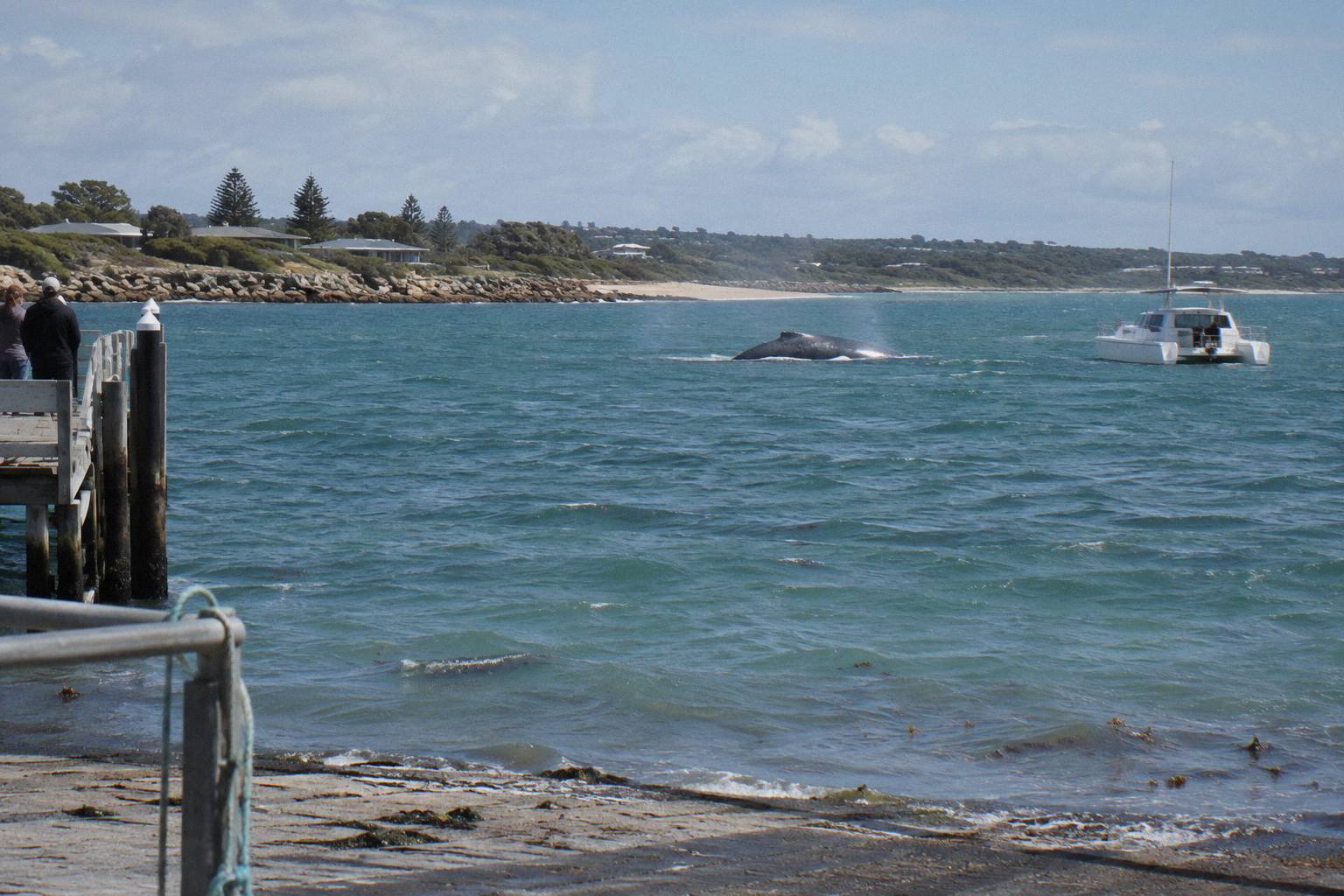
The figures come straight from Schedule 5 of the regulations, and they are worth reading as geometry rather than as a single number. The 300 metre rule protects the animal's path: a boat sitting in front of or behind a whale is in its runway, so the law pushes vessels further out along that axis. To the side, where the whale is not travelling, 100 metres is the floor. The full text sits in the official regulations published by the WA Parliament, and the state environment department repeats the practical version: stay back, approach from the side only if at all, and abandon any interaction at the first sign of distress.
Dolphins get their own, shorter distances, 50 metres for a person and 100 metres for a vessel, and dolphins are the ones most likely to close that gap themselves. Naturaliste Charters notes that dolphins often ride the bow wave of its Dunsborough cruises, which is a good reminder of how this works: the law limits how close people go, and the animals decide how close they stay.
| Who or what | Distance from a whale | Distance from a dolphin |
|---|---|---|
| Person in the water | 100 m | 50 m |
| Vessel, to the side | 100 m | 100 m |
| Vessel, in the front or rear arc | 300 m | 100 m |
| Drone | 60 m | Not stated |
For a passenger, the table translates simply. The boat you are on will hold station at or beyond those distances, the skipper manoeuvres sideways rather than into the whale's line of travel, and if the captain announces the engines are going to neutral, that is not the encounter ending. It is usually the encounter beginning.
One more point on the law, because it explains an odd gap people notice. Regulation 112 says the distance rules do not apply to activity authorised under a licence or by the department's CEO. That carve-out is how the licensed in-water humpback program at Ningaloo exists at all, hundreds of kilometres north. It does not apply to any tour on this coast, and no operator here holds such a licence.
If a whale closes the gap itself, the crew's job becomes predictability rather than evasion. A drifting vessel has not broken the rules when the animal does the approaching, so the response is to hold position and keep a steady heading rather than steer away. From the rail it can look like the crew is doing nothing; in practice, stillness is the manoeuvre.
One geometry point that helps on deck: the front and rear arc moves with the whale. A boat sitting legally to the side can slide into the 300 metre zone the moment the animal turns toward it, which is one reason skippers carry a buffer beyond the published minimums instead of sitting on them.
The drone figure deserves attention too, because 60 metres is almost nothing for a camera in flight. A drone launched from a beach or jetty can cross that line above a passing whale within seconds, and the fine attaches to breaking any of the listed distances, not to vessels alone. Anyone hoping for aerial shots should keep the aircraft well back and let the zoom do the work.
What Happens When A Whale Approaches The Boat
Regulation 114 covers exactly this. If a whale comes inside the distance, the person in charge must put the vessel in neutral or switch off, or move away at no more than 6 knots until the legal distance is restored. A swimmer approached by a whale must move away. The boat never pursues, and the whale is never herded closer.
This is the clause that produces the moments people remember. The skipper sees a whale closing, pulls the throttle back, and the boat becomes a floating object in the bay rather than a vessel. Whales investigate floating objects. Humpbacks in particular are known to circle, pass beneath, or surface within arm's-reach-of-the-rail distance of a boat that has gone quiet, and they do it entirely on their own terms.
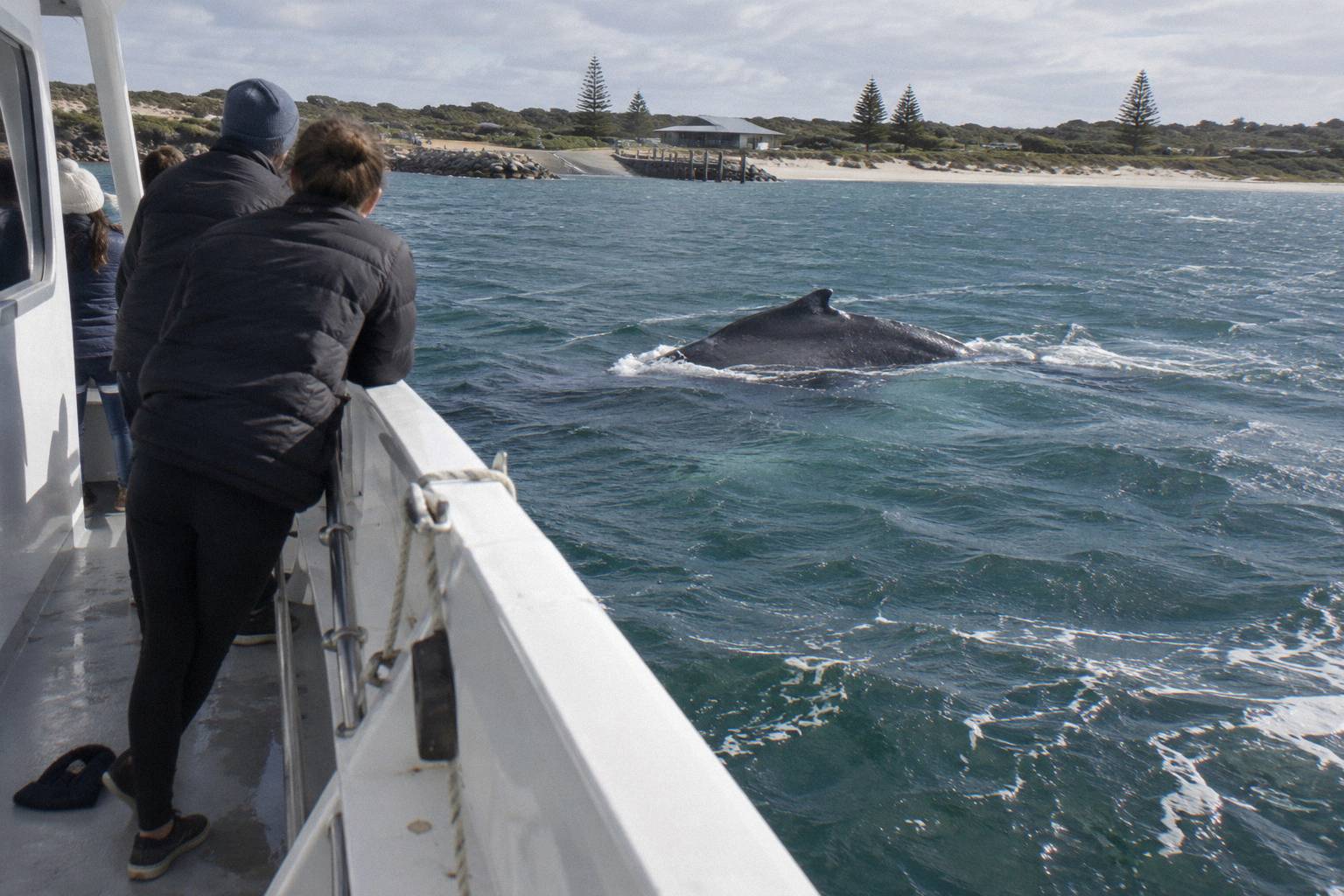
The 6 knot figure matters more than it looks. It is a slow crawl, walking pace, so a departing boat never creates a wake the animal might chase or a propeller strike risk near a curious calf. The crew's job under the rule is to open the gap gently. Your job as a passenger is simpler: stay behind the rails, keep hands and cameras inside the boat, and let the animal control the distance. Nothing in the law or in any operator's briefing invites touching, reaching or calling the whale over.
A word on cameras and drones, since the bay's flat water tempts both. The 60 metre drone limit applies to whales, and it carries the same fine exposure as the vessel distances. If you want to know which rail gives the best view when an animal does come close, the which side of the boat is best for whale watching question has its own answer.
For a fuller legal read, including the swim-with-whales question, see how close whale cruise boats can legally get.
Why Whales Choose To Come Near At All
The whales in Geographe Bay are mostly travelling or resting, not feeding, and a resting whale in shallow, protected water has the spare attention to investigate a quiet boat. Mothers and calves use the bay as a nursery stop on the southward migration, and the bay's shape gives them calm conditions that encourage lingering near vessels.
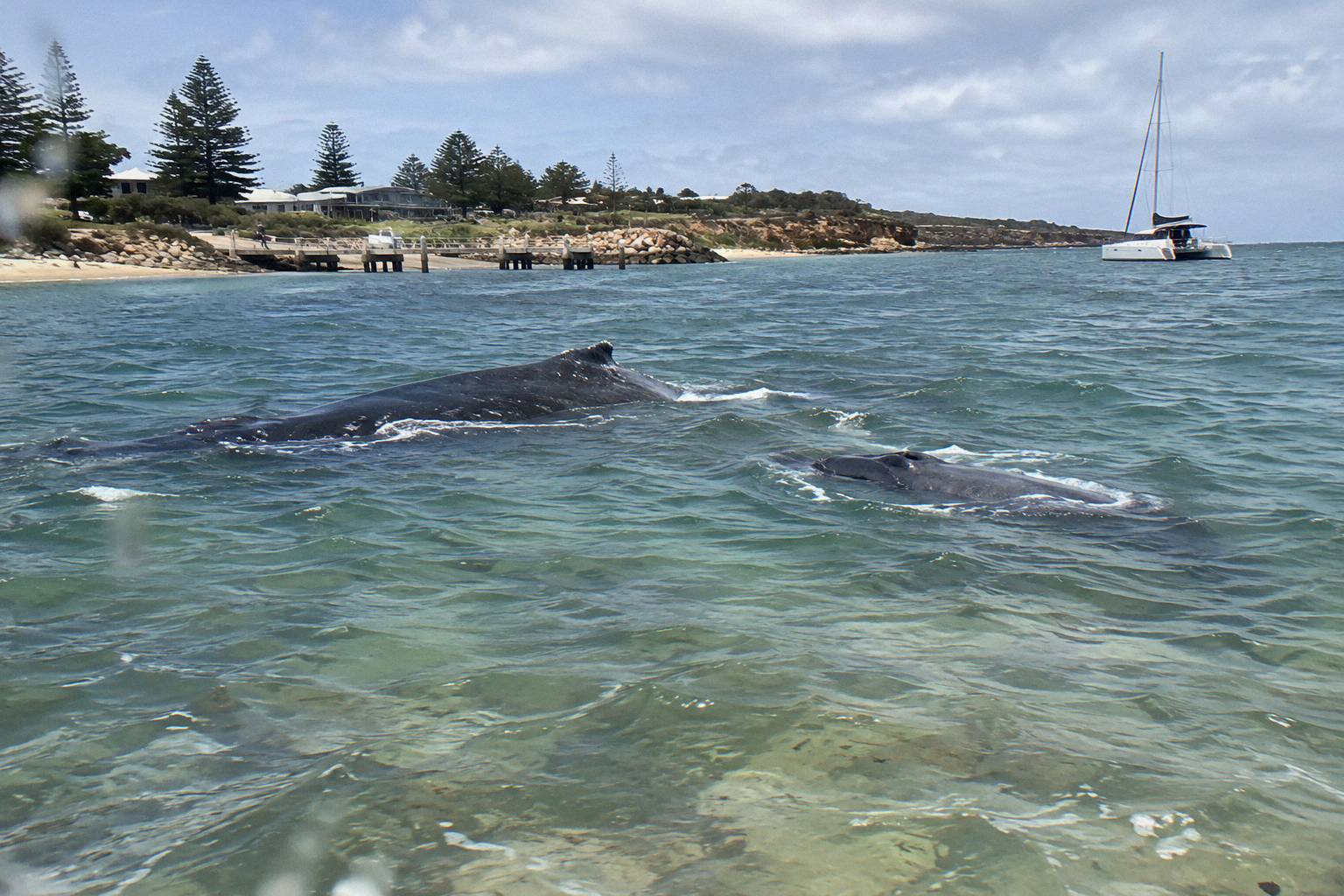
No operator can promise an approach, and none tries to. What they can say is what the bay is for. The southern migration funnels humpbacks past Cape Naturaliste from late winter, and Geographe Bay's broad, shallow sweep is where mothers and calves pause on the way south. A calf learning to swim, breathe and whale-watch is a curious animal, and calves are often the ones that bring mothers within viewing distance of a boat sitting in neutral.
The species mix adds variety. Southern right whales breed and nurse in sheltered south coast waters including Geographe Bay. Pygmy blue whales pass through in spring, mostly from October to December, using the bay and the Naturaliste Plateau as a narrow transit corridor, and minke whales turn up in October and November as chance encounters. Each behaves differently around a boat, and none of them follows a script.
The honest framing is this: closeness in Geographe Bay is a gift, not a guarantee. The odds of seeing a whale on a cruise are one question, and the odds of an approach inside 100 metres are another, unmeasured one. The rules exist precisely because approaches happen often enough to need a protocol, and the protocol exists so the animals keep choosing to come back to the boats.
Can You Swim With The Whales Instead?
The department is blunt about it: "Under State legislation, it is illegal for individuals to swim within 100m of a whale," as stated on the DBCA swimming with humpback whales page. No Dunsborough operator holds a licence for in-water interactions, and the regulation 112 licence carve-out that permits the Ningaloo program has no equivalent on this coast. Any product suggesting otherwise is not a Geographe Bay whale cruise.
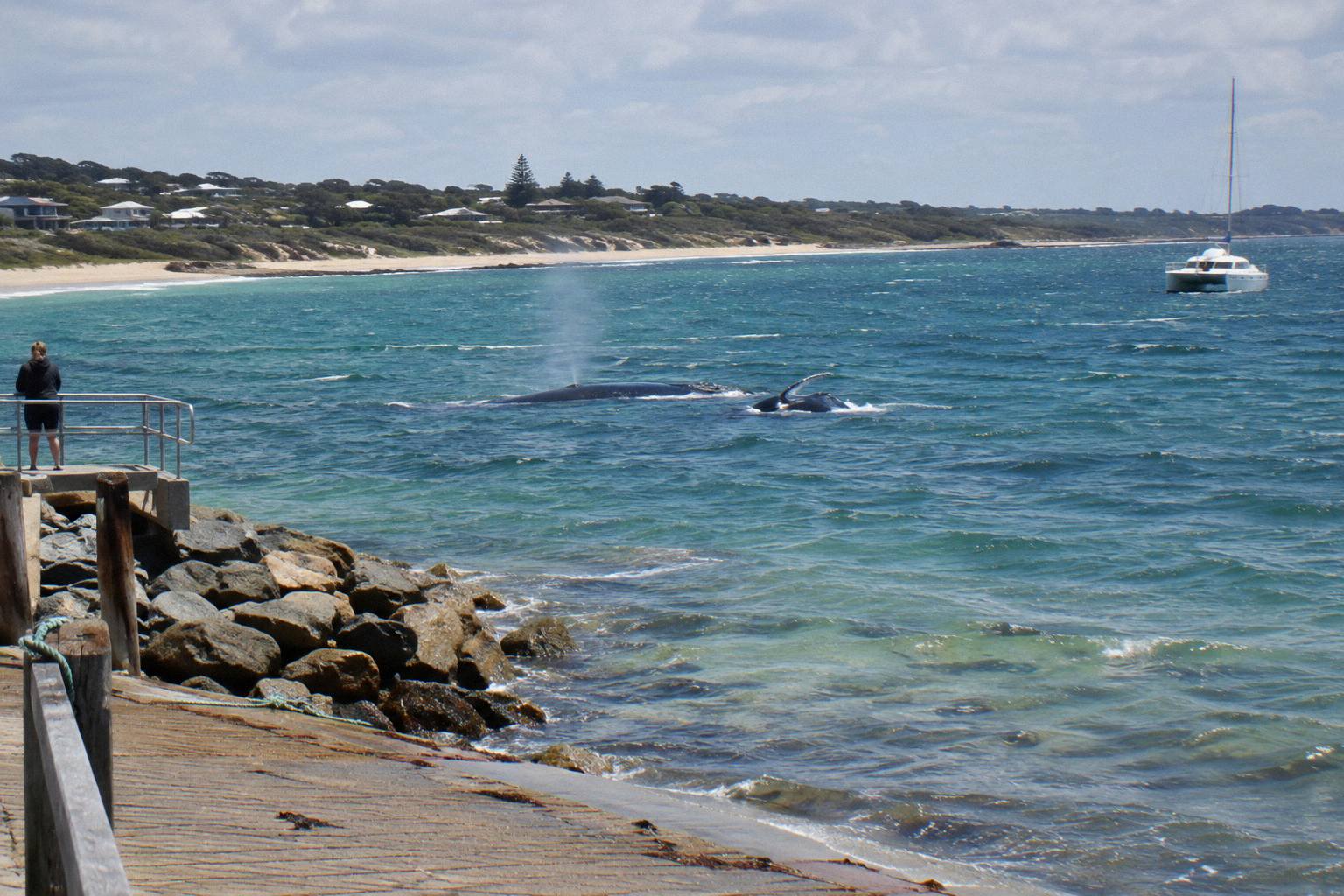
The distinction matters because "close to the boat" and "in the water with" are legally opposite things. The boat, handled correctly, is the safe platform. A person in the water is the one the 100 metre person-distance rule targets, and regulation 114 even requires a swimmer approached by a whale to move away. If you want the fuller background, the question can you swim with humpback whales in Western Australia is answered in detail elsewhere.
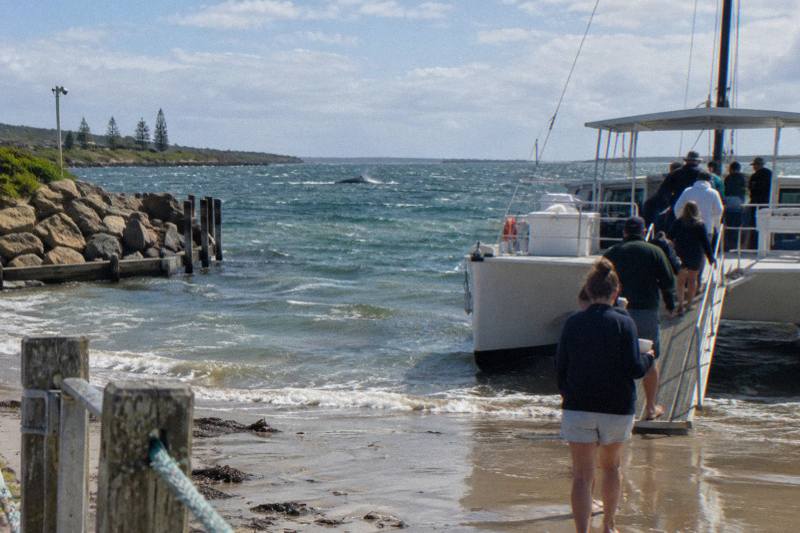
What Geographe Bay does offer instead is water-level viewing from a boat that boards from the beach. The Naturaliste Charters Dunsborough trip has guests walk a handrailed ramp onto the Indi Maree, then transfer to the larger Alison Maree, a 23 metre catamaran, before the cruise proper begins. Being low to the water at the ramp, then steady on a wide deck, is as close to the surface world of the bay as the law allows.
Which Cruises Run From Dunsborough
Two licensed operators run whale cruises from the Dunsborough side of Geographe Bay, with the featured trip departing the Quindalup ramp daily at 10am and 2pm through a season running roughly mid-August to the end of November. A second operator departs from Geographe Bay Road, and Augusta runs a separate season from May to mid-August.
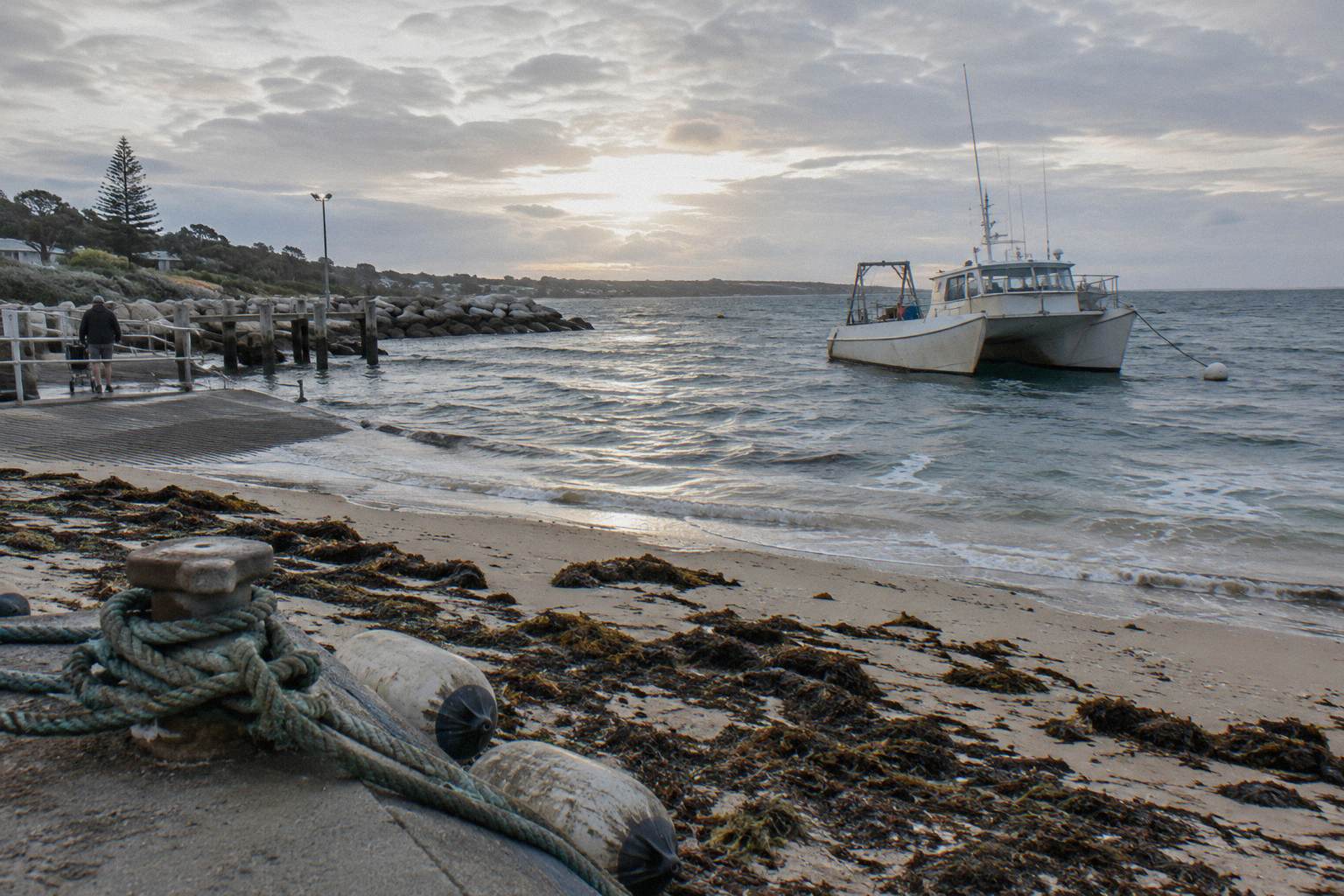
The Dunsborough Whale Watching Tour With Naturaliste Charters is the trip this site features for close-encounter viewing: a listed 2.5-hour cruise, rated 4.7 across 137 reviews, with the booking page showing AUD 71 per person, a figure that can change. The operator allows up to 3 hours depending on wildlife sightings, which is worth knowing, because an animal lingering near the boat is one of the reasons a cruise runs long. Free cancellation up to 24 hours applies on the booking page.
All Sea Charters runs the other Dunsborough departure, a cruise of roughly 2.5 to 3 hours whose price is shown on the booking page rather than printed here. It is rated 4.8 across 438 reviews, and it carries the same free-cancellation window up to 24 hours. If your dates fall outside the Dunsborough season, the Augusta Whale Watching Tour With Naturaliste Charters covers the May to mid-August window from Augusta Boat Harbour, rated 3.9 across 14 reviews, a small pool, with the booking page showing AUD 71 per person.
| Cruise | Rating and reviews | Duration | Season window |
|---|---|---|---|
| Dunsborough Whale Watching Tour With Naturaliste Charters | 4.7 from 137 reviews | listed 2.5 h | mid-August to end of November |
| All Sea Charters, Dunsborough | 4.8 from 438 reviews | listed 2 to 2.5 h | mid-August to early December |
| Augusta Whale Watching Tour With Naturaliste Charters | 3.9 from 14 reviews | listed 2 h | May to mid-August |
Two non-whale-cruise options round out the bay if your interest is marine life generally rather than whales specifically.
The Geographe Bay Eco And Snorkel Trip, runs 2 hours with an optional snorkel and a minimum age of 6, price on the booking page. It is not a whale cruise, but it puts you on the same water with a different brief. How the two departure points compare for the whale trips is covered in the Busselton or Dunsborough whale cruise comparison.
What A Close Encounter Actually Feels Like From The Deck
The pattern is consistent across accounts: the boat holds its lawful distance, the crew spots whales, and the engines go quiet. From there the whale writes the script, surfacing alongside, passing under the hull, or simply travelling on, and the crew narrates what each behaviour means. Passengers who understand this rhythm enjoy the slow passes as much as the close ones.
The moment to watch for is silence. A boat underway in Geographe Bay has engine noise, wake and wind. The instant the skipper calls neutral, the deck goes still, the water sound changes, and everyone on board leans in, because everyone learns quickly that stillness is when whales come to look. A humpback rising beside a motionless hull, exhaling at the surface, is close enough that no binoculars are needed.
Not every cruise gets that. Some days the whales pass at the regulation distance and keep travelling, and the view is blows, flukes and backs on the horizon, which is its own spectacle. The crew will not chase to improve it. The understanding to carry aboard is that distance is the default and closeness is a bonus the animal grants, which is also, honestly, what makes it land so hard when it happens.
Dolphins are the reliable filler. They frequently ride the bow wave on the way out and back, and a common comment in guest reviews is that the dolphin escort on the return leg salvaged a thin whale day. Bring layers, because spring air on the bay averages a maximum of 17 to 19 degrees Celsius from August to October and the sea sits at roughly 17 to 19 degrees, and the on-deck tea and coffee the Dunsborough operator provides earns its keep. If the swell worries you more than the whales do, the seasickness on a Geographe Bay whale cruise guide is the practical read.
If a close pass is the whole point of the trip for you, pick the cruise that fits your season window, book the departure that suits, and let the bay do the rest.
Common Questions About Whales Near Boats In Geographe Bay
Do Whales Come Close To The Boat In Geographe Bay?
Yes. Vessels must keep at least 100 metres to the side of a whale and 300 metres in the front or rear arc, but whales are free to approach, and in a rest-stop bay like Geographe they often do. When one closes the gap, the crew cuts the engines or drifts away at no more than 6 knots, which is when the closest viewing happens.
How Close Can A Whale Watching Boat Legally Get To A Whale?
A vessel must stay at least 100 metres to the side of a whale and 300 metres within a 60 degree arc to its front or rear. A person in the water must stay 100 metres away and a drone 60 metres. Staying closer is an offence with a fine of AUD 5,000.
What Happens If A Whale Swims Up To The Boat?
Regulation 114 requires the person in charge to put the vessel in neutral or switch off, or move away at no more than 6 knots until the distance is restored. The boat never pursues the whale, and passengers stay behind the rails while the animal controls the encounter.
Do Dolphins Come Close Too?
Frequently. Dolphins have shorter legal distances, 50 metres for a person and 100 metres for a vessel, and they commonly close that gap themselves. Naturaliste Charters notes dolphins often ride the bow wave on its Dunsborough cruises.
Can I Get In The Water With The Whales In Geographe Bay?
No. It is illegal for individuals to swim within 100 metres of a whale in Western Australia, and licensed in-water humpback interactions run only in Ningaloo Marine Park State waters and the Muiron Islands Marine Management Area. No tour on this coast offers a swim.
Which Months Give The Best Chance Of A Close Encounter?
The Dunsborough season runs from about mid-August to the end of November, with humpbacks and southern rights in the bay and mothers and calves resting on the southward return. Blue whales pass through from October onwards. No operator can promise an approach in any month, so treat closeness as a bonus rather than a booking criterion.